
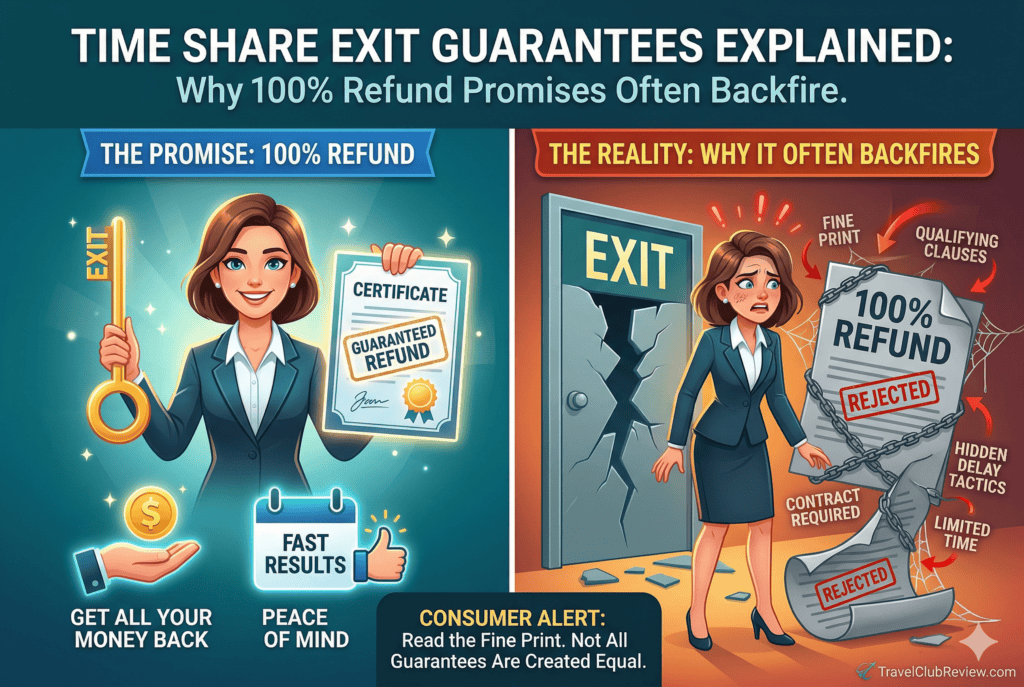
Why “Guaranteed” Timeshare Exits Attract Desperate Owners
Timeshare owners who feel trapped by maintenance fees, loan balances, or limited booking value are highly responsive to messages that promise certainty. The Federal Trade Commission has warned that many exit companies advertise guaranteed results, but some operations simply do not deliver what they promise.
That dynamic is especially powerful because the target audience is often under financial pressure or aging out of the product. In the FTC’s 2022 action against Consumer Law Protection and related companies, regulators alleged that the defendants used scare tactics and high-pressure sales pitches to extract more than $90 million from consumers, most of them older adults.
Why the Refund Promise Often Backfires
The biggest issue is that “refund guarantee” language may not mean “you get your money back if you are unhappy.” In the Washington Attorney General’s case against Reed Hein & Associates, the state alleged that the company treated almost any termination of ownership as a successful “exit,” even if the result was foreclosure or if the owner found a way out independently. Under that definition, the company could still argue no refund was owed.
That structure creates a trap. The customer pays thousands upfront for a supposedly low-risk service, but the contract may let the company count outcomes the owner did not want, or work the owner did not cause, as proof of performance.
A second problem is timing. Some agreements stretch “completion” timelines for many months or even years, leaving the owner outside their practical window to dispute charges or recover funds. BBB complaint pages and posted contract excerpts also show guarantee language paired with long fulfillment windows, including statements that some terminations may take up to 24 months.
A third problem is evidentiary. When the sales call emphasizes certainty but the contract is full of conditions, the written agreement usually controls. Verbal promises like “full refund, no questions asked” may not help much if the actual refund clause is conditioned on narrow triggers or extensive exclusions.
If you’re still evaluating your options, start with a broad overview of all the legitimate paths to get out of a timeshare, check out our complete cancellation services guide.
The Loopholes Buried Inside Many Guarantees

The exact wording varies, but several patterns appear repeatedly in regulatory actions, complaint records, and industry commentary.
- The company defines success broadly. If the timeshare ends for any reason, the company may treat that as a completed exit and deny a refund, even when the owner secured the result alone or the resort foreclosed.
- The company says the case is still active. A business may deny a refund by claiming it is “still working” on the file, leaving the consumer in limbo for months or years.
- The guarantee is void if the owner acts independently. Some contract language penalizes owners who contact the resort, negotiate directly, or find their own release path.
- Refunds may be blocked once work starts. Vague clauses about services being “initiated” can give the company a reason to keep the fee even if the owner is still fully obligated on the timeshare.
- Long timelines reduce leverage. If the contract allows 12 to 24 months for performance, chargeback and complaint deadlines may become harder to use effectively.
Not sure what your contract actually says? If you have a travel club, vacation club, or timeshare agreement, I can review it in plain English and flag the terms that deserve the most attention before you sign or miss a cancellation deadline.
What Regulators and Watchdogs Have Found
Public enforcement history matters because it shows these concerns are not hypothetical. In 2021, Reed Hein agreed to a Washington settlement requiring at least $2.61 million in restitution and other payments after the state alleged the firm misled consumers about money-back guarantees and other claims.
In a separate action, the FTC’s 2022 case against Consumer Law Protection and related companies alleged bogus affiliation claims, deception about owners’ ability to exit on their own, and repeated failures to honor promised refunds.
Minnesota announced settlements in 2025 with three companies that marketed timeshare exit help and charged thousands in upfront fees while violating the state’s debt-settlement law. The settlements were expected to return nearly $270,000 to consumers.
The practical takeaway: once state attorneys general and the FTC repeatedly warn that guarantees can be misleading, owners should treat any “100% refund” claim as a contract-analysis problem, not a reassurance.
What Real Complaint Patterns Suggest
Complaint platforms do not prove every allegation, but they are useful for spotting recurring themes. BBB complaint pages and Trustpilot reviews repeatedly reference high upfront fees, slow progress, disputes over whether the company performed, and frustration getting refunds that consumers believed were guaranteed.
Consumer narratives on Trustpilot and Reddit also show a recurring pattern: some owners report they ultimately found a cheaper direct or attorney-led route, while others say the company claimed the file was complete or still in process even though the owner felt no meaningful service had been delivered.
That does not mean every exit provider is fraudulent. It does mean the phrase “money-back guarantee” should never be taken as proof of low risk without reviewing the exact contract terms, complaint history, legal standing, and actual refund conditions.
Red Flags That Should Slow the Buyer Down 
Be especially cautious when several of these signals appear together:
- Large upfront fees before meaningful work begins.
- Claims that you cannot exit without paying the company first.
- Guarantees of fast results, fixed timelines, or certain cancellation.
- Pressure to sign on the same day or lose the opportunity.
- Vague explanations of the legal strategy.
- Refund language that depends on the company’s sole discretion or an undefined “successful completion.”
- No mention of whether the resort itself has a surrender, deed-back, or owner transition program.
Think you’ve been scammed? See our article Timeshare & Travel Club Scams 2026: New Tactics, Red Flags, and How to Protect Yourself
Safer Alternatives to Try First
For many owners, the lowest-risk starting point is the resort or developer, not a third-party exit company. The FTC advises consumers to contact the timeshare company first, and some developers offer deed-back, surrender, or buyback-style programs, particularly when the owner is current on fees and carries no remaining loan balance.
Those programs are not perfect, and they rarely refund the original purchase price. But they are often cheaper and more direct than paying a third party several thousand dollars based on a guarantee that may be very difficult to enforce.
When direct surrender is not available, the next-best path may be a licensed attorney with a clearly defined scope, jurisdiction-specific advice, and written fee terms. Even then, verify credentials, ask how the strategy works, and avoid anyone promising certainty that no lawyer can honestly guarantee.
Questions Every Owner Should Ask Before Paying

A strong screening process can expose weak guarantees fast.
- What exact event triggers a refund? Ask whether a refund is available if the company fails to obtain a written release from future obligations by a stated deadline.
- Does foreclosure, default, or owner-obtained surrender count as your success? If yes, the guarantee may protect the company more than the customer.
- How long can the company keep the file open before a refund becomes available? Long windows increase consumer risk.
- Can the owner still contact the resort directly without voiding the guarantee? Restrictive language here is a major warning sign.
- Are fees held in escrow or earned immediately? If funds are fully collected upfront, refund leverage may be weak.
- What do BBB complaints, Trustpilot reviews, and attorney general records show? Patterns matter more than polished marketing pages.
Have a travel club or timeshare contract you’re unsure about? Request a plain-English contract review before you sign or miss a cancellation deadline.
Frequently Asked Questions

Are timeshare exit guarantees real?
Some companies do put guarantee language in writing, but that does not mean the promise is broad, automatic, or easy to enforce. Regulators have alleged that certain guarantees were misleading because refund eligibility was tied to how the company defined success or delay.
Why do 100% refund promises fail so often?
They often fail because the contract includes loopholes tied to timing, owner conduct, broad definitions of “exit,” or the company’s claim that work has already started or the file is still active.
Is contacting the resort first a better idea?
Often, yes. The FTC advises owners to contact the timeshare company first, and some developers offer deed-back or surrender programs that can be cheaper and more direct than third-party services.
Can a legitimate attorney guarantee a timeshare cancellation?
No ethical attorney should promise certainty about an outcome controlled by contract terms, counterparties, and jurisdiction-specific facts. A lawyer may explain strategy and probability, but a guaranteed result is a warning sign, not a selling point.