
by Kiando | Last Updated September 2026
Disclosure: This guide is based on current federal pricing guidance and publicly available vacation-package terms. We may earn an affiliate commission if you use links on this page, at no extra cost to you. Our conclusions remain editorially independent. Learn how we review and earn revenue →
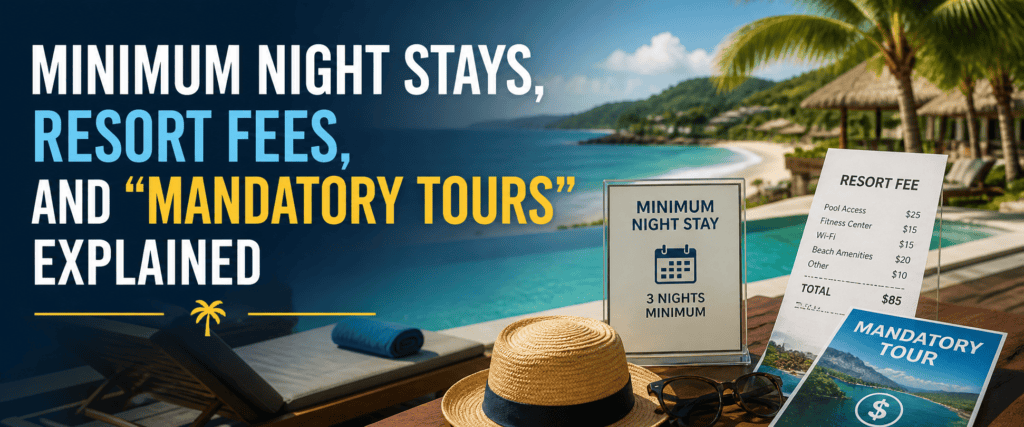
Quick answer: A minimum stay controls how many nights you must book. A resort fee is a mandatory property charge, although covered U.S. lodging sellers must now include known, unavoidable fees in the most prominent advertised total. A “mandatory tour” is usually a required timeshare sales presentation tied to a promotional rate. Miss the presentation or fail the eligibility rules, and the cheap trip can be repriced, forfeited, or stripped of its incentives.
Those are three different restrictions, but vacation offers have a habit of stacking them like a particularly annoying layer cake. The only useful comparison is the full cost and obligation of the package versus the trip you would have booked without it.
The three terms at a glance
| Term | What it controls | What to verify | Main risk |
|---|---|---|---|
| Minimum stay | The fewest nights you can reserve | Dates, property, room type, and whether the rule changes by season | Buying nights you did not want |
| Resort fee | A required lodging charge, often tied to amenities | The displayed total, taxes, optional add-ons, and payment timing | Comparing a partial price with an all-in price |
| Mandatory tour | Attendance at a sales presentation or owner update | Length, attendees, eligibility, timing, and the penalty for noncompliance | Losing the promotional rate or being charged more |
What a minimum night stay means
A minimum night stay is a booking rule requiring a reservation of at least a certain length. It might apply only to a holiday weekend, a particular resort, promotional inventory, a room type, or a discounted rate. A three-night minimum is not automatically unfair. It becomes a value problem when the required stay is longer than the trip you actually want.
Before treating a package price as savings, ask whether the same minimum applies to a normal public booking. Also check whether you can add nights at the promotional rate, whether the dates must be consecutive, and whether changing dates restarts the booking process or adds a fee.
Travel clubs can bury similar restrictions inside points charts, booking calendars, or seasonal availability rules. Test the dates you are likely to use, not a Tuesday in the least popular month merely because the sales demo found an opening.
Resort fees changed, but they did not disappear
Resort fees are mandatory charges associated with a stay, often described as covering Wi-Fi, pools, fitness centers, local calls, or other property amenities. The fee may still exist even if you never use those amenities.
The important U.S. pricing change is disclosure. The Federal Trade Commission’s Rule on Unfair or Deceptive Fees took effect on May 12, 2025. For covered short-term lodging, a seller that displays a price must show the total price, including mandatory fees it knows and can calculate upfront, more prominently than other pricing information. The FTC specifically uses a nightly resort fee as an example of a charge that belongs in that total.
The rule did not ban resort fees. It changed how covered businesses must present them. Government-imposed taxes and genuinely optional extras may still be excluded from the first displayed total, but the final payment amount must be disclosed before payment. The FTC also says the rule does not set a specific number of nights that qualifies as “short-term.”
Taxes, resort fees, and incidentals are not the same thing
Package language often groups several charges together even though they behave differently:
- Government taxes: These may be added separately from the first displayed price, subject to the FTC rule’s disclosure requirements.
- Mandatory resort or destination fees: For covered lodging, known and unavoidable charges belong in the displayed total.
- Optional extras: Parking, upgrades, insurance, or other services may be separate when you genuinely choose them.
- Security holds and incidentals: These may not be final charges, but they can temporarily reduce your available credit and still matter to your trip budget.
Do not use a page about annual travel club maintenance fees as a substitute for the hotel terms. Annual ownership dues and nightly resort charges are different costs. Check both when a promotional stay is connected to a longer-term membership pitch.
What a “mandatory tour” actually is
In promotional vacation packages, “tour” usually means a timeshare or vacation-club sales presentation. The package discount is conditional on completing it. “No obligation to purchase” does not mean “no obligation to attend.”
Current public terms show how specific the conditions can be. Holiday Inn Club Vacations states that its offer requires a two-hour timeshare sales presentation. Club Exploria’s marketing-package terms require a minimum 90-minute presentation for purchasers and describe age, income, identification, credit-card, household, and prior-tour restrictions.
The fine print can also dictate who attends. Some offers require a spouse or domestic partner to be present, matching addresses on identification, or all owners on an account to attend an owner update. Other terms restrict group travel, recent presentations, local residents, or overlapping promotional packages.
What happens if you skip the presentation?
There is no universal penalty. Read the terms for your exact offer. Possible outcomes include:
- being charged the difference between the promotional price and the retail value of the accommodations;
- losing gifts, rebates, or other incentives;
- forfeiting the package price or future use of the package;
- paying a stated penalty, change fee, no-show charge, or daily rental rate; or
- being disqualified because another required traveler did not attend.
Club Exploria’s current public terms, for example, say that failure to attend or meet the requirements can lead to a charge for the full retail value of accommodations and gifts, less the package purchase price. That is why a low package price is not the same thing as a low-risk booking.
Use this all-in package test
Compare the offer using the same dates, room type, cancellation terms, and travelers:
Promotional-package cost = package price + government taxes + separately charged mandatory costs + transportation or parking for the presentation + required extra nights + the value you place on the presentation time.
Regular-booking cost = the refundable or realistically cancellable public price for the stay you actually want, including mandatory charges and taxes.
Then compare the cancellation rules. A promotion can be cheaper on paper and still be the worse choice if the dates are rigid, the package is nonrefundable, or one sick traveler can trigger repricing.
Compare the same stay without the sales presentation
Before accepting a promotional package, price the same destination, dates, and room type as a regular hotel booking. Compare the final total, cancellation terms, and included amenities, not merely the first advertised rate.
Compare hotel prices on Booking.com
Affiliate link: Travel Club Review may earn a commission if you book through this link, at no extra cost to you. Compare the final checkout total and rate terms before paying.
Red flags in the offer terms
- The ad emphasizes a per-night or “starting at” figure instead of the full package total.
- The presentation is called a welcome meeting, tour, discovery session, or owner update without stating that attendance protects the discount.
- The eligibility rules appear after payment or conflict with what the salesperson said.
- The offer does not explain the charge for missing, arriving late to, or being disqualified from the presentation.
- The room is subject to availability, but the refund or expiration terms leave you carrying the risk.
- The sales pitch compares the promotion with a vague “retail value” rather than a bookable public rate for the same dates and room.
Questions to get answered in writing
- What is the minimum stay, and does it change by date, resort, or room type?
- What is the complete price for my dates, including mandatory charges and taxes?
- Is the package refundable, transferable, or extendable?
- Who must attend the presentation, and how long is the required session?
- What age, income, residence, relationship, identification, credit, or prior-tour rules apply?
- What exact amount can be charged if anyone misses the presentation or is disqualified?
- Are gifts delivered before or after completion, and can their stated value be charged back?
- Which document controls if the salesperson’s description conflicts with the written terms?
If the agreement is already in front of you, do not rely on a verbal summary. Our Travel Club Reality Check reviews the document in plain English and flags the price, deadline, usage, fee, and sales-presentation terms that deserve a closer look. It is decision support, not legal advice.
Bottom line
Minimum stays are usage rules. Resort fees are pricing components. Mandatory tours are sales obligations. Judge each one separately, then add them back together before calling the offer a deal.
The biggest correction to older travel advice is that covered U.S. lodging sellers should no longer reveal known mandatory resort fees only at the end of the booking path. But all-in price display does not protect you from rigid dates, excluded taxes, optional charges, presentation requirements, or penalties written into a promotional package. The contract still gets the last word, because apparently vacations needed homework.
Frequently asked questions
Are resort fees included in the advertised hotel price?
For covered U.S. short-term lodging, the most prominent displayed total must include mandatory fees the seller knows and can calculate upfront. Government taxes and genuinely optional extras may be shown separately. The rule requires clearer pricing; it does not ban resort fees.
What is a mandatory tour on a vacation package?
It is usually a required timeshare or vacation-club sales presentation tied to a promotional lodging rate or incentive. You may have no obligation to buy, but you can still be required to attend and satisfy the offer’s eligibility rules.
Can a minimum stay make a travel deal more expensive?
Yes. A discounted nightly rate can cost more overall when you must reserve more nights than you planned. Compare the total for the required stay with a normal booking for the trip you actually want.
What happens if I do not qualify for the timeshare presentation?
It depends on the offer. Some terms allow the operator to reprice the accommodations, remove incentives, charge a stated fee, or forfeit the package. Verify the eligibility rules before paying and bring the required identification and payment card.
Does the FTC junk-fee rule apply to minimum stays or timeshare presentations?
The rule governs price disclosure for covered short-term lodging and live-event tickets. It does not ban minimum-stay requirements or sales presentations. Those conditions still need to be evaluated under the specific package terms and other applicable law.