
Disclosure: We may earn a commission if you book through the Expedia link in this article. Our case-study quotes came from the sources listed below.
Flying into Rome and starting your journey home in Venice can spare you a separate trip back to Rome before departure. Whether it saves money depends on more than the flight price.
In our eight-night Italy comparison, the open-jaw airfare cost $89 more for two adults.[1][2]
The selected hotel and intercity-rail changes, however, reduced costs by €257.80.[7][8][10]
The open-jaw return also included a connection through Rome, so it did not mean a nonstop flight home or a shorter flight day.[2]
Our verdict: Compare the trip you would actually take, including the last hotel night, baggage and the journey back to your departure airport. An open-jaw itinerary is worth considering when those changes improve the vacation enough to justify any additional cost. It is not an automatic airfare discount.
Research checked October 21, 2026. Prices below are dated quotes for two adults, not reservations, guaranteed offers or evidence of firsthand travel. The comparison covers specified flights, hotels and intercity trains, not the full cost of a vacation.
What is an open-jaw flight?
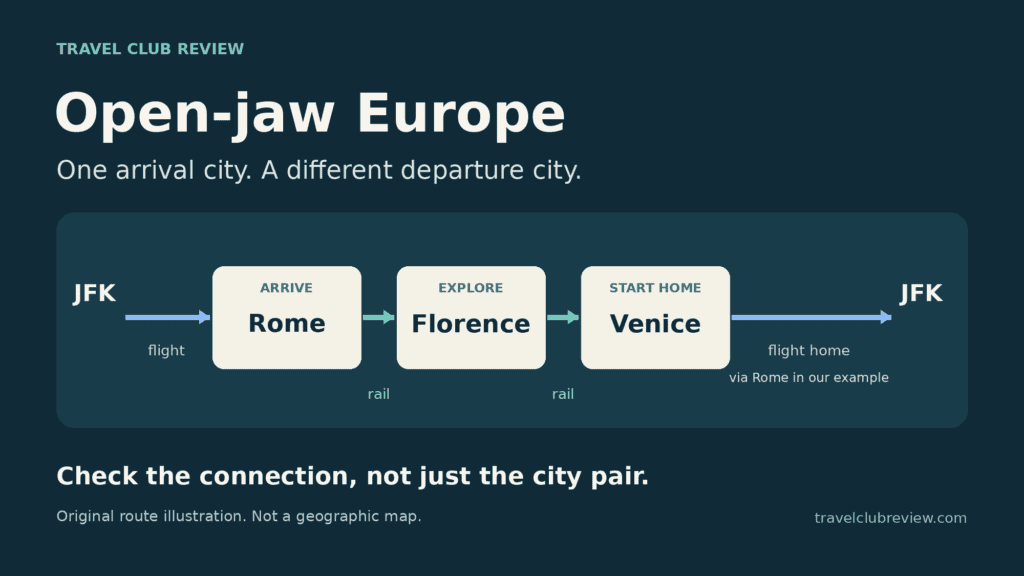
A common open-jaw itinerary starts with a flight into one city and ends with a flight home from another. You arrange the journey between those destinations separately.[3]
For example:
- Fly from New York JFK to Rome.
- Visit Rome, Florence and Venice, traveling between them by train.
- Fly from Venice back to JFK.
Search the flights using the multi-city option. That lets you compare the intended journey with a conventional round trip rather than assume two separately purchased one-way tickets will provide the same price and conditions.[3]
An open jaw describes the route. Before paying, check the actual ticket arrangement, who sells and services it, the connection details and the rules for each booked component.
Our test: the same dates, with a different final night
We priced an example for two adults departing JFK on March 9, 2027, arriving in Italy on March 10 and returning on March 18. Both versions have eight hotel nights.
Open-jaw version
- Rome: March 10–13, three nights.
- Florence: March 13–15, two nights.
- Venice: March 15–18, three nights.
- Return flight starts at Venice Marco Polo Airport.
Rome round-trip version
- Rome: March 10–13, three nights.
- Florence: March 13–15, two nights.
- Venice: March 15–17, two nights.
- Rome: March 17–18, one night before flying home.
The final Rome overnight is a deliberate buffer before an international flight, not an unavoidable requirement of every round-trip itinerary. A traveler willing to leave Venice earlier or use a different return schedule could make another choice.
This comparison therefore matches travel dates, total nights and the selected room products, but not identical sightseeing time. One version keeps the final night in Venice; the other spends it in Rome. If you want another evening in Rome, that is a benefit rather than wasted time.
Flights: match the bags before comparing the price
We selected ITA itineraries with the same outbound flight and the same Rome-to-JFK transatlantic return flight. For both, we used the Google Flights booking option labeled Economy Comfort, showing one checked bag and one carry-on per passenger.[1][2]
- Rome round trip: $1,683 for two adults. JFK–Rome outbound; Rome–JFK home.
- Open jaw: $1,772 for two adults. The same JFK–Rome outbound; Venice–Rome–JFK home.
- Open-jaw airfare premium: $89 for the party.[1][2]
Google listed both selected fare options as nonrefundable, with no change fee but a possible fare difference. Seat selection was listed as an additional charge. These are the conditions displayed for those particular options, not a promise about every ITA economy fare.[1][2]
The initial round-trip search card showed $1,283, but that was the lighter fare without checked bags. Using it against the baggage-inclusive open-jaw fare would have exaggerated the difference.[1]
These prices came from Google Flights’ selected-itinerary booking options, including required taxes and fees for two adults. The airline handoff was blocked during our check, so we did not independently reconfirm the final airline checkout. Optional seat charges were not included. We matched these ITA products rather than claim they were the cheapest flights available across every airline and seller.[1][2]
Trains: price the journey that the round trip adds
We selected the same Standard-class, Super Economy fare category on the following Frecciarossa services. All prices are for two adults, and times are local to Italy.[7]
- March 13, Rome Termini → Florence Santa Maria Novella: train 9524, 10:05–11:46, €47.80.
- March 15, Florence Santa Maria Novella → Venice Santa Lucia: train 9406, 09:20–11:34, €55.80.
- March 17, Venice Santa Lucia → Rome Termini: train 9413, 10:26–14:30, €85.80. Only the Rome round-trip version needs this selected positioning journey.[7]
That gives €103.60 for the open-jaw version and €189.40 for the Rome round trip. The selected Venice-to-Rome train takes four hours and four minutes, before hotel-to-station travel and any waiting time.[7]
These were journey-selection quotes, not completed purchases. The selected Super Economy offers did not allow reservation changes or refunds, and optional paid seat choice was off. Other promotions were visible, so these matched selections should not be read as the cheapest possible combination of rail fares.[7]
Hotels: replace the final night rather than add a ninth one
We priced one room for two adults through the hotels’ official booking channels. The selected rates included breakfast and offered cancellation before stated deadlines. We kept the same property and room when changing a stay’s dates; we did not estimate a new stay by multiplying a headline nightly price.[8][9][10]
The captured totals, including the quoted city taxes, were:
- Hotel Smeraldo, Rome: Double Superior Room, March 10–13. €894 room rate plus €36 city tax: €930.[8]
- Hotel Davanzati, Florence: Classic Double Room / Twin Beds, March 13–15. €331 accommodation plus €24 city tax: €355.[9]
- Hotel Al Codega, Venice: Classic Room with double bed, March 15–18. €404 room rate plus €27 city tax: €431.[10]
- The same Venice room, March 15–17: €275 plus €18 city tax: €293.[10]
- The same Rome room, March 17–18: €298 plus €12 city tax: €310.[8]
Open-jaw hotel total: €1,716. Rome round-trip hotel total: €1,888. In this example, replacing the final Venice night with the Rome overnight increases the hotel cost by €172.[8][9][10]
These are specific central-city rooms, not a claim that all three properties have an identical star rating or service standard. Within each city, the comparison uses the same selected room and rate product. Displayed hotel prices were in whole euros.
Cancellation terms also need their own comparison. Rome’s rate showed a 72-hour policy; Venice’s showed a five-day policy. Florence’s selected-rate summary showed free cancellation until March 5, while its policy prose said seven days before arrival. We would seek written clarification of that discrepancy before relying on a deadline. We did not find exact cutoff times and timezones in the captured rate summaries.[8][9][10]
Comparing other places to stay? Browse Rome hotel listings on Expedia, then check your dates, room type, taxes and cancellation terms. These are marketplace alternatives, not the direct hotel quotes above. We may earn a commission if you book through this link.
What the priced components tell us
For these selections, the comparison is:
- Rome round trip: $1,683 airfare, plus €2,077.40 for the specified hotels and intercity trains.
- Open jaw: $1,772 airfare, plus €1,819.60 for the specified hotels and intercity trains.
These subtotals add the flight, room and rail quotes itemized above; they are not full vacation budgets.
The open-jaw version has a $89 airfare premium and a €257.80 hotel-and-rail advantage. Using the European Central Bank’s October 20, 2026 reference rate of $1.1215 per euro, that is approximately $200 less for these selected components combined. This conversion is a reference calculation, not a card or booking-site exchange rate.[11]
That is not a $200 guaranteed vacation saving. The subtotal excludes airport and hotel transfers, local transport, meals other than the included breakfasts, attractions, insurance, paid seat choices and card or currency-conversion fees. Different dates, hotels, fares or a different positioning plan can change the result.
Airport transport is a good example of what remains to check. The current official Leonardo express tariff was €14 per adult between Fiumicino Airport and Rome Termini. ACTV’s Venice airport bus ticket was €10 per adult, but that is not a waterbus or a door-to-hotel transfer. Neither tariff was verified as a guaranteed March 2027 price, and neither has been included in our subtotal.[12][13]
Open-jaw does not mean nonstop, or no return through the first city
Our open-jaw option starts its journey home in Venice, but connects through Rome. The selected flights leave Venice at 11:20, connect at Fiumicino for two hours and 25 minutes, then take the same 14:55 Rome-to-JFK flight as the conventional round trip.[2]
Google showed 13 hours and 35 minutes for Venice–Rome–JFK, versus 10 hours for Rome–JFK. The open-jaw return flight journey is therefore three hours and 35 minutes longer.[1][2]
Its advantage is avoiding our chosen previous-day train and hotel change, while retaining the final Venice night. It is not a claim that the flight home is faster. Nor can we simply subtract the train time from the flight time and call the result a door-to-door time saving: the two versions start from different cities and place travel on different days.
How to compare an open-jaw trip before booking
Start with the vacation route, then test the flight options against it.
- Choose the actual airports. Keep the origin airport consistent and distinguish a convenient city airport from one requiring a longer transfer.
- Match the fare products. Include the bags you expect to bring, and compare seat charges, change terms and refundability. Cabin labels alone are not enough. ITA’s published hand-luggage allowance, for example, specifies an eight-kilogram carry-on limit; check the operating airline’s own rules rather than assume all cabin bags qualify.[4]
- Map every ground leg. Include stations, departure times, transfers and how you get between the hotel and the airport or station.
- Price changed hotel stays separately. A final-night switch can change both the room total and city taxes. Do not add a ninth hotel night to one version without explaining the extra vacation day.
- Check the seller and ticket structure. Establish who will service a change and whether the components are issued together or separately. Do not assume a multi-city search screen answers those questions.
- Compare equivalent booking offers. If a marketplace helps you find a train or hotel, check its actual product, total price and cancellation terms against the supplier’s offer. A similar listing is not necessarily the same rate.
- Recheck before paying. A saved quote is evidence of what was displayed at a particular time, not a reservation.
Keep money and time as separate decision factors. A slightly higher price may be reasonable if it preserves the evening you most want. A cheaper itinerary may still be a poor choice if its transfers or restrictions do not suit you.
Book it yourself or use a travel advisor?
For a straightforward itinerary, start by checking whether you are comfortable selecting the flights, booking the ground legs and managing each supplier’s rules. If you are, an advisor’s fee needs to buy something you actually value.
An advisor may be worth considering when the itinerary includes several travelers with different needs, complicated transfers, multiple countries, or arrangements you do not want to coordinate yourself. Before paying, ask:
- What is the planning fee, and what work does it include?
- Which reservations will the advisor make and service?
- Are changes charged separately, and who pays supplier penalties or fare differences?
- What happens if a flight change disrupts a train, transfer or hotel booking?
- Is help available during the trip, including outside office hours?
- How are commissions, preferred suppliers and alternatives disclosed?
Do not assume that paying for planning includes unlimited changes, refunds or round-the-clock assistance. The written service scope should answer those questions.
For the broader distinction between membership and travel-planning services, see our guide to travel clubs versus travel agencies.
Where Royal Expression Travels fits
Royal Expression Travels is a relevant example of an agency discussing this itinerary style. In a Travel Weekly article sponsored by United Airlines, founder LaDell Carter describes the company’s use of open-jaw travel.[6]
That establishes the firm’s stated approach, not an independent endorsement or proof that an advisor will save you money. Its own contact page advertises starting trip budgets of $25,000. That is a trip-budget statement, not a published planning fee, and it is not a like-for-like quote for our Italy example.[5]
We did not obtain an agency proposal, planning-fee quote or service agreement. We therefore cannot judge whether Royal Expression, or any other advisor, would provide better value than these independently priced bookings.
Frequently asked questions
Are open-jaw flights always cheaper?
No. Our selected open-jaw airfare was $89 higher for two adults.[1][2]
Its cost advantage came from the specified hotel and rail changes, before unpriced local and airport transfers.[7][8][10]
Can an open-jaw return connect through my original arrival city?
Yes. Our selected Venice-to-JFK journey connected through Rome. Check the flight segments, not just the departure and destination shown at the top of the search.[2]
Do I need a travel agent to book one?
You can begin with a multi-city flight search and compare the ground arrangements yourself.[3] Whether to pay for planning depends on the itinerary’s complexity, your confidence and the advisor’s actual service scope.
Should I buy two one-way tickets instead?
Price that option, but compare the full fare rules, baggage, seller and ticket arrangement. Do not assume separately purchased one-ways match the price or servicing terms of the combined itinerary you found.[3]
What is the quickest useful comparison?
Compare the flight-price difference with the transportation and hotel changes required to return to the original airport. Then inspect the actual return-flight connections and the destination time each version preserves. That is more useful than comparing airfare alone.
Our recommendation
Build the open-jaw version alongside the round trip before committing to either. In our Italy example, keeping the final night in Venice reduced the selected hotel and rail costs enough to offset the higher airfare at the reference exchange rate. It also meant a longer return-flight journey and an extra flight connection.
Choose the version that fits the vacation you want, after checking the remaining transfers and final booking terms. The useful question is not whether open-jaw travel is always better. It is whether returning to your first airport is worth what your particular trip requires.
How we researched this comparison
We checked public booking screens on October 21, 2026, using two adults and the stated March 2027 dates. Flights were selected-itinerary Google Flights booking options. Rail prices were direct Trenitalia journey selections. Hotel prices came from booking engines reached through the properties’ official websites, with selected rooms, occupancy, dates and city-tax treatment recorded. The hotel links below identify those official channels; dated quote captures are retained in our research records.
No tickets or rooms were purchased. We did not stay at these hotels, test disruption support, obtain an advisor quote or verify airline checkout. This is a comparison of selected products, not a search for the cheapest possible vacation. Availability, prices, taxes and policies can change. The airport-transfer figures are current published tariffs, not future dated booking quotes.
Sources
- Google Flights: selected JFK-Rome round trip, two adults, March 9–18, 2027
- Google Flights: selected JFK-Rome / Venice-JFK trip, two adults, March 9–18, 2027
- Going: How to Book Open-Jaw Flights to Save Time and Money
- ITA Airways: hand luggage
- Royal Expression Travels: contact and advertised trip budgets
- Travel Weekly: The Value of Open-Jaw Travel, sponsored by United Airlines
- Trenitalia: dated two-adult journey selections, March 2027
- Hotel Smeraldo: official booking channel; dated room quotes retained
- Hotel Davanzati: official booking channel; dated room quote and policy retained
- Hotel Al Codega: official booking channel; dated room quotes retained
- European Central Bank: October 20, 2026 reference exchange rates
- Trenitalia: Leonardo express published tariff
- ACTV: Venice urban services and airport ticket tariff